Google Shatters Records: $102.3B Q3 Revenue Marks First $100 Billion Quarter in Company History
Mountain View, California – October 29, 2025 — In a historic achievement that underscores the enduring dominance of Big Tech, Alphabet Inc. (NASDAQ: GOOGL) reported third-quarter revenue of $102.35 billion, marking the company's first-ever $100 billion quarter and crushing Wall Street expectations. The blockbuster results, announced after the market close Wednesday, sent shares surging in after-hours trading as investors celebrated the tech giant's ability to monetize artificial intelligence while maintaining its core advertising supremacy.
1. The Record-Breaking Numbers
Google's Q3 2025 performance exceeded even the most optimistic analyst forecasts, demonstrating that the company's massive investments in AI infrastructure are beginning to pay tangible dividends:
- Total Revenue: $102.35 billion (vs. $99.89 billion expected) — Beat by 2.5%
- Earnings Per Share: $2.87 (significantly above consensus)
- Year-over-Year Growth: 16% increase from $88.3 billion in Q3 2024
- Operating Income: $31.29 billion
- Net Income: $34.98 billion (up from $28.52 billion year-over-year)
- Operating Margin: Strong profitability maintained despite heavy AI spending
The symbolic breakthrough past the $100 billion quarterly revenue threshold represents a watershed moment for Alphabet, validating CEO Sundar Pichai's aggressive strategy of pouring tens of billions into AI capabilities while competitors like Meta and Amazon scramble to catch up.
2. Google Cloud: The Star Performer
Perhaps the most impressive aspect of Google's quarter was the explosive growth of Google Cloud Platform (GCP), which has emerged as the company's fastest-growing major business segment and a key driver of AI monetization:
- Cloud Revenue: $15.15 billion (vs. $14.74 billion expected) — Beat by 2.8%
- Year-over-Year Growth: 33.5% increase from $11.35 billion in Q3 2024
- Sequential Growth: Accelerating momentum from previous quarter
- Operating Margin: Continued improvement in profitability
AI Driving Enterprise Adoption
The cloud division's outperformance validates Google's thesis that enterprises are willing to pay premium prices for cutting-edge AI capabilities. During the earnings call, Pichai highlighted that "our Gemini models now process 7 billion tokens per minute via direct API use by our customers," demonstrating massive adoption of Google's first-party AI models in real-world enterprise applications.
The growth is particularly impressive given persistent concerns about capacity constraints that have limited Google's ability to serve all incoming demand. Analysts had worried that infrastructure bottlenecks might cap cloud growth, but the beat suggests Google is successfully scaling its data center capacity to meet surging AI workload requirements.
3. Search and Advertising: The Cash Cow Keeps Printing
While much attention focused on Cloud and AI, Google's core advertising business—which still generates the vast majority of revenue—delivered robust growth that defied concerns about AI disruption:
- Google Services Revenue: $82.5 billion, up 12% year-over-year
- Search and Other Revenue: $54.2 billion, growing 12% across all verticals
- YouTube Advertising: $10.26 billion (vs. $10.01 billion expected) — Beat by 2.5%
- YouTube Growth: 15% increase from $8.92 billion year-ago quarter
- Traffic Acquisition Costs (TAC): $14.87 billion, slightly above $14.82 billion estimates
AI Overviews: Enhancing Not Destroying Search
One of the quarter's most significant revelations was that AI Overviews—Google's generative AI-powered search results—are expanding rather than cannibalizing traditional search monetization. The feature now serves over 2 billion users monthly globally, and early data suggests users are actually clicking on more ads after interacting with AI-generated summaries.
"Our AI Overviews are rolling out at record speed," Pichai emphasized during the call, noting that the feature has now launched in over 120 countries. The rapid global expansion demonstrates Google's confidence that AI-enhanced search strengthens rather than threatens its advertising business model.
4. YouTube: Monetization Machine Firing on All Cylinders
YouTube's performance exceeded expectations across both advertising and subscription revenue streams, reinforcing the platform's status as the world's dominant video content ecosystem:
Advertising Strength
YouTube advertising revenue of $10.26 billion represented 15% year-over-year growth, significantly outpacing traditional television advertising markets. The growth was broad-based across:
- Short-form video (Shorts): Continued monetization improvements
- Connected TV: The fastest-growing YouTube viewing platform
- Brand advertising: Recovery in brand spending after 2024 slowdown
- Direct response: Performance advertising continues scaling
Subscription Services Surging
The "Google subscriptions, platforms, and devices" category—which includes YouTube Premium, YouTube TV, YouTube Music, and Google One—reported $12.87 billion in revenue, up from $10.66 billion in the year-ago quarter. This represents over 20% growth in high-margin subscription revenue that reduces Google's dependence on advertising volatility.
5. The $85 Billion Question: CapEx and AI Infrastructure
While revenue and profitability impressed, the elephant in the room remains Google's staggering capital expenditure program to build AI infrastructure. The company previously announced plans to invest approximately $85 billion in CapEx in 2025, up from an earlier estimate of $75 billion.
The Bull Case: Necessary Investment
Management argued forcefully that these investments are essential to maintaining competitive positioning in the AI race:
- Demand exceeds capacity: More enterprise customers want AI services than Google can currently serve
- Competitive imperative: Microsoft, Amazon, and Meta are spending similarly aggressive amounts
- Long-term monetization: AI workloads command premium pricing and high margins
- 2026 increase expected: Management signaled CapEx will rise further next year
The Bear Case: Margin Pressure
Skeptics worry the spending spree will compress margins and limit near-term profitability:
- Depreciation wave coming: As new data centers come online, depreciation expense will surge
- Uncertain returns: Whether AI investments generate proportional revenue growth remains unproven
- Arms race dynamics: Competitive pressure may force continued spending regardless of returns
- Opportunity cost: Capital deployed to data centers can't be used for buybacks or acquisitions
For now, investors appear willing to give management the benefit of the doubt, as evidenced by the positive after-hours stock reaction.
6. Other Bets: Still Losing Money, But That's Expected
Google's "Other Bets" division—which includes moonshot projects like self-driving car unit Waymo, health technology venture Verily, and internet infrastructure project Google Fiber—continues operating at a loss, though this surprises no one:
- Revenue: $344 million (down from $388 million year-ago quarter)
- Operating Loss: $1.43 billion (compared to $1.12 billion loss year-ago)
- Waymo expansion: Robotaxi service expanding to new cities including London
While the losses continue mounting, these ventures are explicitly long-term bets with decade-plus time horizons. Waymo in particular has made significant progress, recently receiving permits for driverless operations in New York City and announcing plans for European expansion.
7. The AI Strategy: Full-Stack Dominance
Pichai's comments on the earnings call emphasized Google's "full-stack approach to AI" as the key differentiator versus competitors:
Model Leadership
Google's Gemini AI models have rapidly climbed performance leaderboards, with the company now claiming:
- Processing scale: 7 billion tokens per minute through APIs
- Consumer adoption: Gemini app reached #1 on Apple's App Store, surpassing ChatGPT
- Enterprise traction: Major corporations adopting Gemini for mission-critical applications
- Multimodal capabilities: Leading performance in vision, text, and code generation
Infrastructure Advantage
Google's vertical integration—controlling everything from custom AI chips (TPUs) to data centers to end-user applications—provides cost and performance advantages that pure-play competitors struggle to match. This "full-stack" control enables:
- Faster model training and deployment cycles
- Better cost efficiency per inference
- Tighter integration between models and products
- Proprietary optimizations unavailable to competitors
8. Regulatory Overhang: Antitrust Wins Provide Relief
A significant backdrop to this quarter's results was Google's recent antitrust victory regarding its search advertising practices. Earlier in Q3, a federal judge ruled that Google could continue using proprietary data from its search engine for advertising purposes—a decision that removed a major uncertainty hanging over the stock.
What Was at Stake
Had the ruling gone the other way, Google might have been forced to:
- Separate its search and advertising businesses
- Share search data with competitors
- Limit how it uses search behavior for ad targeting
- Potentially spin off major business units
Remaining Challenges
Despite this win, regulatory pressure remains intense:
- European Union: Ongoing scrutiny of adtech practices and search dominance
- DOJ investigations: Multiple antitrust probes continue
- State attorneys general: Coordinated actions challenging Google's market power
- International regulators: Increased enforcement in markets like India, South Korea, and Australia
9. Beating the Trillion-Dollar Club: How Google Stacks Up
Google's $102 billion quarter positions it favorably against other members of the exclusive $3 trillion market cap club:
Versus Microsoft
Microsoft recently reported strong results driven by Azure cloud growth, but Google's 16% overall growth rate exceeded Microsoft's ~13% pace. Google Cloud's 33% growth also outpaced Azure's high-20s percentage increase, suggesting Google is gaining market share in enterprise cloud.
Versus Amazon
Amazon Web Services (AWS) remains the cloud market leader by revenue, but Google Cloud's faster growth rate suggests the gap is narrowing. Google's AI-specific capabilities—particularly in generative AI workloads—appear to be resonating with enterprise customers looking beyond AWS's traditional infrastructure offerings.
Versus Meta
Meta recently reported solid results driven by advertising recovery and AI-driven engagement improvements. However, Google's $10.26 billion in YouTube advertising dwarfs Meta's video advertising revenue, and Google's search dominance provides a moat Meta can't replicate.
10. Stock Reaction and Market Implications
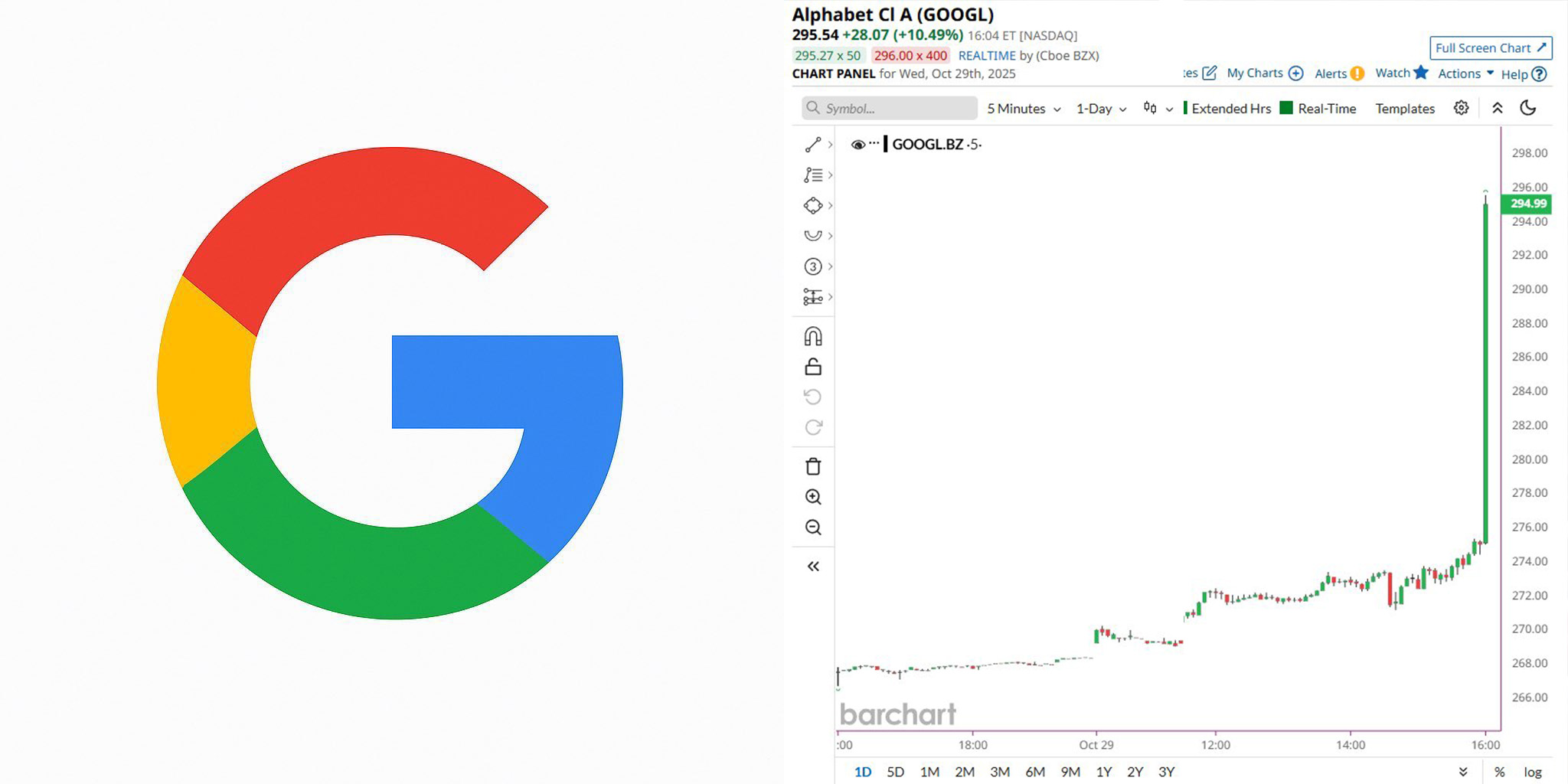
Alphabet's stock jumped approximately 4-5% in after-hours trading following the earnings release, adding roughly $120-150 billion in market capitalization instantly. The enthusiastic response reflects several factors:
Exceeding High Expectations
Coming into the report, GOOGL stock was trading near all-time highs around $268, having recently crossed the $3 trillion market cap threshold. Many feared the stock was "priced for perfection," leaving little room for upside. The decisive beat on revenue, earnings, and key segments proved that even elevated expectations were too conservative.
AI Monetization Proof Point
The quarter provided concrete evidence that AI investments are translating into revenue, not just buzz. Cloud growth acceleration, Search resilience despite AI Overviews, and margin maintenance all demonstrate that Google is successfully monetizing generative AI rather than merely spending on it.
Competitive Positioning Validated
By beating across Search, YouTube, and Cloud while maintaining profitability, Google proved it isn't losing ground to Microsoft, Amazon, or emerging AI competitors. The results suggest Google's integrated ecosystem—spanning consumer products, advertising, and enterprise services—provides durable competitive advantages.
11. Analyst Reactions: Upgrades and Price Target Raises Likely
Wall Street analysts, who had set a median price target around $270 before earnings, are expected to raise targets in the coming days:
Bull Analysts Vindicated
The most optimistic analysts had argued Google was undervalued relative to its AI capabilities and market position. This quarter's results support that thesis, with some now discussing $300+ price targets based on:
- Multiple expansion if AI revenue growth sustains
- Cloud profitability improving faster than expected
- Search monetization proving more resilient than feared
- Regulatory risks diminishing after recent court victories
Bear Case Weakened
Skeptics had warned about:
- AI cannibalizing search revenue (not happening)
- CapEx destroying margins (margins holding up)
- Cloud growth slowing (actually accelerating)
- Competition from Microsoft and OpenAI (Google gaining share)
Each of these concerns was addressed positively in the Q3 results, forcing bears to reconsider their positions.
12. Risks and Concerns: What Could Still Go Wrong
Despite the stellar quarter, several risks remain that could derail Google's momentum:
CapEx Spiral
Management's signal that CapEx will increase further in 2026 raises concerns about an AI spending arms race with no clear end. If competitors match Google's spending, returns on invested capital could disappoint, leading to margin compression and multiple contraction.
Regulatory Uncertainty
While Google won its recent antitrust case, multiple investigations continue. A future adverse ruling could force structural changes to the business, potentially separating high-synergy units or limiting data usage that drives advertising effectiveness.
AI Competition Intensifying
OpenAI, Anthropic, and other AI-native companies continue innovating rapidly. If OpenAI's GPT models or Anthropic's Claude achieve decisive performance advantages, enterprise customers might shift workloads away from Google Cloud, undermining the growth narrative.
Advertising Market Cyclicality
Google's revenue remains heavily dependent on advertising, which is inherently cyclical. An economic recession or advertising market downturn could quickly reverse revenue growth, particularly if brand advertisers pull back spending as they did in 2023-2024.
13. Looking Ahead: Q4 and 2026 Outlook
While Google doesn't provide explicit quarterly guidance, management commentary offered clues about future expectations:
Q4 2025 Expectations
- Seasonal strength: Q4 typically sees advertising surge during holiday shopping season
- CapEx completion: Many data center projects coming online in Q4, potentially constraining Cloud growth
- Comparison challenges: Tough year-ago comps as Q4 2024 saw strong recovery
- Foreign exchange: Dollar strength could create revenue headwinds
2026 Themes
Management highlighted several priorities for 2026:
- Agentic AI adoption: Pichai forecast 2026 as "the year of agents" with AI automating complex task chains
- Cloud capacity expansion: More data centers coming online to meet demand backlog
- Gemini Pro growth: Scaling consumer subscriptions for advanced AI features
- International expansion: Waymo's London launch marks entry into European markets
- Workspace AI integration: Deeper embedding of AI throughout productivity tools
14. Conclusion: The $100 Billion Milestone and What It Means
Google's $102.35 billion quarter represents far more than a numerical milestone—it's a definitive statement about the company's ability to thrive in the AI era while maintaining dominance in its legacy businesses.
The results validate Sundar Pichai's controversial decision to invest $85+ billion annually in AI infrastructure despite Wall Street's initial skepticism. Cloud growth acceleration, Search resilience, and YouTube's continued expansion demonstrate that Google's integrated approach—controlling everything from chips to models to end-user applications—provides competitive advantages that pure-play competitors cannot easily replicate.
Perhaps most importantly, the quarter proved that AI enhances rather than cannibalizes Google's existing businesses. AI Overviews are driving more search engagement, not less. Gemini API adoption is accelerating Cloud growth, not commoditizing it. YouTube's AI-powered tools are increasing creator productivity and viewer satisfaction, strengthening the platform's network effects.
For investors, the message is clear: Google has successfully navigated the treacherous transition from the mobile era to the AI age without sacrificing its core revenue streams or profitability. The company that once seemed vulnerable to disruption from ChatGPT and other AI upstarts has instead reasserted itself as a AI leader with unmatched scale, infrastructure, and monetization capabilities.
The road ahead won't be without challenges. Regulatory scrutiny remains intense, CapEx spending will pressure margins, and competition from Microsoft, Amazon, and AI-native startups will only intensify. But if Q3 2025 demonstrated anything, it's that betting against Google's ability to innovate, scale, and monetize remains a losing proposition.
The first $100 billion quarter won't be the last. And for Google, that's not a promise—it's an expectation.